Ch. 12 - Earth's Interior
Class: GEOL-101
Notes:
12.1 Exploring Earth’s Interior
Explain how Earth acquired its layered structure.
Layers -> zones
Presentation content:
- Earth’s three major interior layers can be further subdivided into zones
- Gravity and chemical differentiation established the three basic divisions
- The densest material (iron) sinks to the center
- The least dense material makes up the outer layers of the planets
- The layers have small horizontal variations in mineral composition and temperature with depth
- These differences indicate that the Earth’s interior is very dynamic
Notes from the lecture:
- Layers are based on chemical differentiation
- Difference in density because of material
/GEOL-101/Visual%20Aids/Pasted%20image%2020251027152318.png)
Mineral and Phase Changes
Presentation content:
- The density of rocks increases toward the center of the planet due to gravity
- Upper mantle rocks have a density of 3.3 g/cm3
- The same rocks in the lower mantle have a density of 5.6/cm3
- The lower mantle rocks undergo a mineral phase change as the minerals are compressed under higher pressures
Notes from the lecture:
- Example: Peridotite xenolith:
- Study and use it to understand the interior composition of the earth.
- We are not sure, we rely on geophysical measurements.
/GEOL-101/Visual%20Aids/Pasted%20image%2020251027152623.png)
- As it is subducted away it is eventually reincorporated to the mantle
Using Seismic Waves to Prove Earth's Interior
Presentation content:
- Most of our knowledge of Earth’s interior comes from the study of earthquake waves
- Seismic velocities
- Travel times of P (compressional) and S (shear) waves through Earth vary depending on the properties of the materials
- Seismic waves travel fastest in stiff (rigid) rocks
- Seismic wave velocities also vary based on the composition of the rocks
- Travel times of P (compressional) and S (shear) waves through Earth vary depending on the properties of the materials
Notes from the lecture:
- We use it to explore for oil and to understand Earth's interior
- Waves can be reflected or refracted
- Refracted = bend outward/downward
- We use a Seismometer
Probing the Earth's Interior
Presentation content:
- Interactions between seismic waves and Earth’s layers
- Seismic waves reflect and refract as they pass through the different layers of Earth
- Allow us to “see” inside the Earth
/GEOL-101/Visual%20Aids/Pasted%20image%2020251027153003.png)
Notes from the lecture:
-
P waves can travel through the different layers of earth but as they reach them they can be reflected or refracted
-
Used to modeling the density of the earth
-
P and S waves travel at different velocities which depend on the properties of the materials that transmit them
- Faster through more rigid materials
- S-waves cannot travel through liquids
/GEOL-101/Visual%20Aids/Pasted%20image%2020251027153136.png)
- Why are there increasing through the Lower mantle?
- Increase in density = increase in pressure
- S waves stop at the outer core because S waves cannot travel through liquids.
12.2 Earth's Layered Structure
List and describe each of the three major layers of Earth’s interior.
Earth's Crust
Presentation content:
- Oceanic crust
- Forms at mid-ocean ridges
- Averages 7 km thick
- Composed of basalt and gabbro
- Average density of 3.0 g/cm3
- Continental crust
- Heterogeneous structure and composition
- Averages 40 km thick
- Thickest (70 km) at mountains like the Himalayas
- Thinnest (20 km) in the Basin and Range region
- Average density of 2.7 g/cm3
/GEOL-101/Visual%20Aids/Pasted%20image%2020251027153459.png)
Notes from the lecture:
- Why can it be really think in some areas?
- Mountains (two plates colliding create a tall mountain)
- Why can it be thin?
- You can stretch it across (changes from compressional to extensional)
Earth's Mantle
Presentation content:
-
Over 82% of Earth's volume is in the mantle, which is the layer between the crust and the core
- Nearly 2900 km thick
- Extends from Moho to the liquid outer core
-
Solid rocky layer composed of silicate minerals rich in iron and magnesium
- Determined based on observations of seismic waves
-
The upper mantle extends from the Moho to 660 km deep
- Composed of peridotite, composed of olivine and pyroxene
- The lithospheric mantle is the uppermost part of the mantle and ranges in thickness from a few km to 200 km
- The asthenosphere is a weak layer beneath the lithospheric mantle
- The lower portion of the upper mantle ranges between 410 and 660 km depth, called the transition zone
-
The lower mantle extends from the transition zone to the liquid core (2900 km deep)
- Earth's largest layer, occupying 56 percent of Earth's volume
- Olivine and pyroxene are converted into perovskite
-
The D” layer is the boundary between the rocky lower mantle and the liquid outer core
- Cool regions are thought to be the remnants of subducted lithospheric plates
- Hot regions are though to be the start of deep mantle plumes
Notes from the lecture:
- Moho
- Changes from rigid to ~plastically layer.
- There is a lot we do not know about but the mantle is responsible for this distribution of heat along the earth and the creation of hot spots
/GEOL-101/Visual%20Aids/Pasted%20image%2020251027153647.png)
Earth's Core
Presentation content:
-
The outer core is liquid, based on the absence of S waves traveling through the core
- The outer core has a density of 9.9 g/cm3
- Composed mostly of iron with some nickel
- 15 percent of the outer core consists of lighter elements
- The core (outer core and inner core) accounts for one-sixth of Earth’s volume but one-third of its mass because it is so dense
- Outer core is 2270 km thick
-
The inner core is a solid, dense sphere (all other layers are shells)
- Has a density of 13 g/cm3
- Is growing as Earth cools at the expense of the outer core
- Rotates faster, and moves independently of, the crust and mantle
- Has a radius of 1216 km
Notes from the lecture:
- Uranium and another heavy elements are thought to be in the outer core.
- Still just simulations, we do not know for certain.
/GEOL-101/Visual%20Aids/Pasted%20image%2020251027154125.png)
- Solid inner core turning -> Why is this bad? it gets rid of our magnetosphere which protects our ozone layer
12.3 Discovering Earth's Layers
Explain how seismic waves were used to discover Earth’s layered structure.
Seismic-wave velocities
Presentation content:
- Studying seismic-wave velocities gives seismologists a layer-by-layer understanding of Earth's composition
- When a seismic wave hits a boundary between different Earth materials some of the waves are reflected and some are refracted
- Velocity of seismic waves increases with depth
- By examining the behavior of a variety of rocks are the pressures corresponding to various depths, geologists have learned about the compositions of Earth's crust, mantle, and core
Discovering the boundaries: The Moho
Presentation content:
- The Moho is the boundary between the crust and the mantle
- Discovered in 1909 through jump in velocity of P waves below the base of the continents
- P wave velocities abruptly increase at the Moho
- Seismic waves refract as they cross the Moho
/GEOL-101/Visual%20Aids/Pasted%20image%2020251027154522.png)
Notes from the lecture:
- Evolution as based on understanding of technology
- A key factor was understanding the velocity of P waves, we wanted to know what kind of bounds they are tight to.
- Before that we can use it to measure things like explosives//dynamite
- You receives your direct waves, then you also receive a number of different refracted waves, eventually you reach a point to where the refracted wave is moving faster (increase in velocity) than the direct waves (outpaces it).
- This increase in velocity is because of ...
- At the Moho there is a difference in density, we use this to map the Moho.
Earth's Mantle
Presentation content:
- Discovering boundaries: The core-mantle boundary
- Beyond 100 degrees from an epicenter, P and S waves are absent or weak
- Called a shadow zone
- S waves cannot travel through liquid
- P waves are considerably refracted through liquid
- The inner core-outer core boundary
- Some P waves are strongly refracted by a sudden increase in velocity at a boundary within Earth’s core
/GEOL-101/Visual%20Aids/Pasted%20image%2020251027155001.png)
Notes from the lecture:
- Inspiration: Measure every time the soviet union was detonating bombs or weapons.
- In that shadow zone you do not find seismic waves.
- This is how we discovered that there is some sort of change in composition/layers on earth
- S-wave shadow zone is much more grater because they cannot pass through liquids.
12.4 Earth’s Temperature
Describe the processes of heat transfer that operate in Earth’s interior and indicate in which layers these processes are dominant.
Heat flow
Presentation content:
- Heat flow from hotter regions to colder regions
- Heat flows from the core to the surface
- Earth’s core is 5500°C
- Earth’s surface is 15°C
- Rate of Earth cooling is determining by estimating heat loss from the Earth’s surface
- Heat flows from the core to the surface
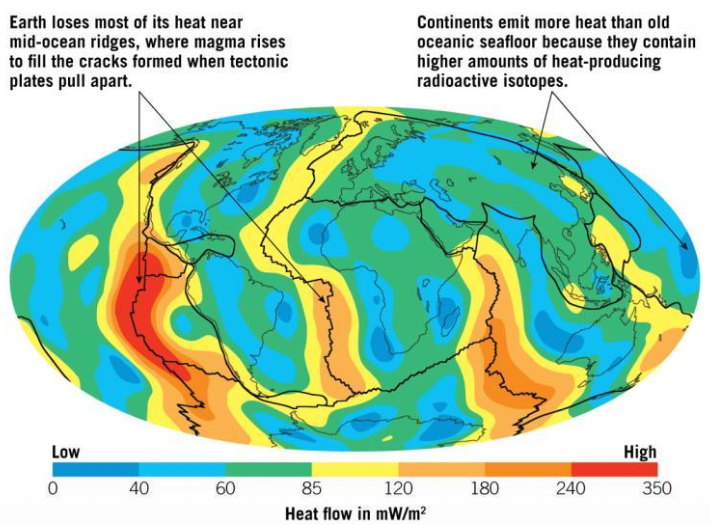
- Hottest along ocean ridges, where plates are separating
- Coolest at old oceanic crust
- Medium heat flow over continents
- They have more lighter minerals associated with them, which then to have more radioactive material associated with them
- 1000s of measurements needed
Notes from the lecture:
- Heat coming outward from the core towards the surface
- Earth overtime has been cooling down, we can tell by looking at the heat loss in the earth surface.
- Think about how many tens of thousands of measurements are needed to make these maps.
How did Earth get so hot?
Presentation content:
- Earth has experienced two thermal stages
- First stage lasted 50 million years when temperatures increased rapidly
- Collision of planetesimals
- Decay of radioactive isotopes
- Asteroid collision that created the Moon
- Second stage involves the slow cooling over the next 4.5 billion years
- Some heat is still generated through radioactive decay in the mantle and crust
- First stage lasted 50 million years when temperatures increased rapidly
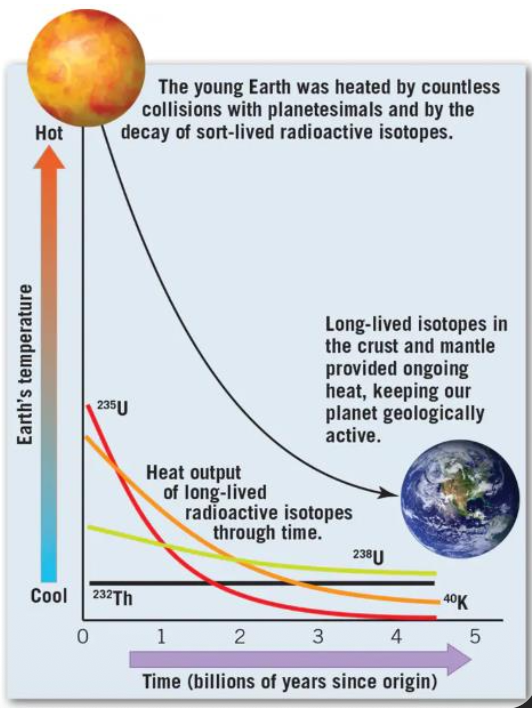
Notes from the lecture:
- Early Earth:
- J. Mars-size object impacts young Earth 4.5 B years ago
- M. ...
How does heat travel?
Presentation content:
- Heat Flow
- Heat travel through Earth by conduction, convection, and radiation
- Convection and conduction occur within Earth’s interior
- Radiation transports heat away from Earth's surface to space

Notes from the lecture:
- Through conduction, convection, and radiation
- Conduction:
- Vibration of an ion makes the next ion vibrate (gasoline is not particularly efficient unless metals)
- Metals are excellent conductors
- At the Inner core and between mantle and outer core, as well as between mantle and lithosphere.
- Convection:
- Think about your stove bowling water: water at the bottom ultimately goes to the top and so on.
- Radiation:
- Sun sending waves to Earth, and we receive them through space
Convection
Presentation content:
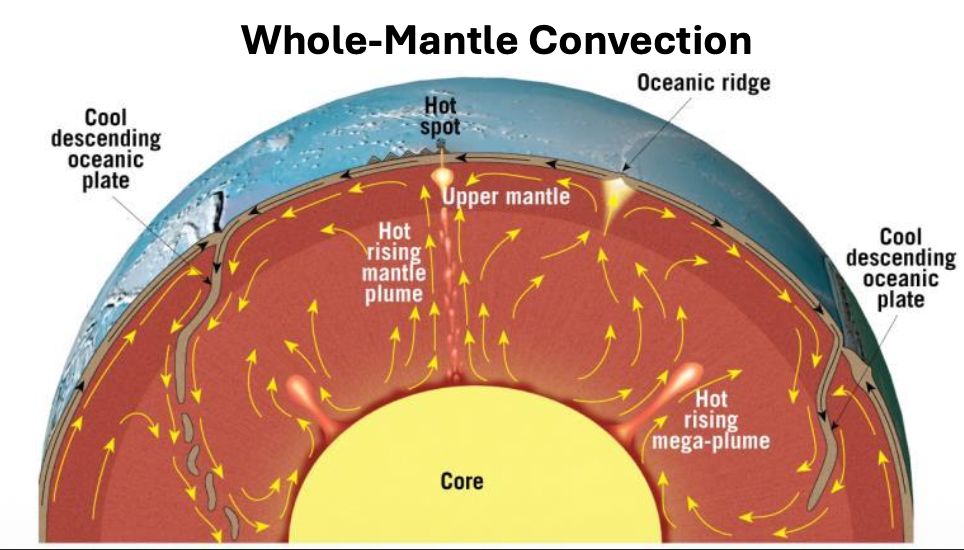
- Convection is the transfer of heat where hot materials replace cold material (or vice versa)
- Primary means of heat transfer within Earth
- Convection cycles occur within the mantle and outer crust
- In the mantle, convection drives plate tectonics as hot material rises and cooler material sinks.
- In the outer core, convection of molten iron generates Earth’s magnetic field through the geodynamo process.
Notes from the lecture:
- Examples: Hawaii and Yellowstone being hotspots
- Idea: weather the plates themselves have a driving force?
- Example: Paper clips chain example
Conduction
Presentation content:
- Conduction is the transfer of heat through a material
- Through the collision of atoms or through the flow of electrons
- Materials conduct heat at different rates
- Metals are better than rocks at conducting heat
- Conduction is not an efficient way to move heat
- Most rocks are poor conductors of heat
- Conduction is important in the solid inner core
- Convection is important from the inner to the outer core
- Top-down, thermally driven convection
- Crystallization and sinking of iron to the inner core drives chemical convection
- Radioactive isotopes provide additional heat to drive convection
Earth's Temperature Profile
Presentation content:
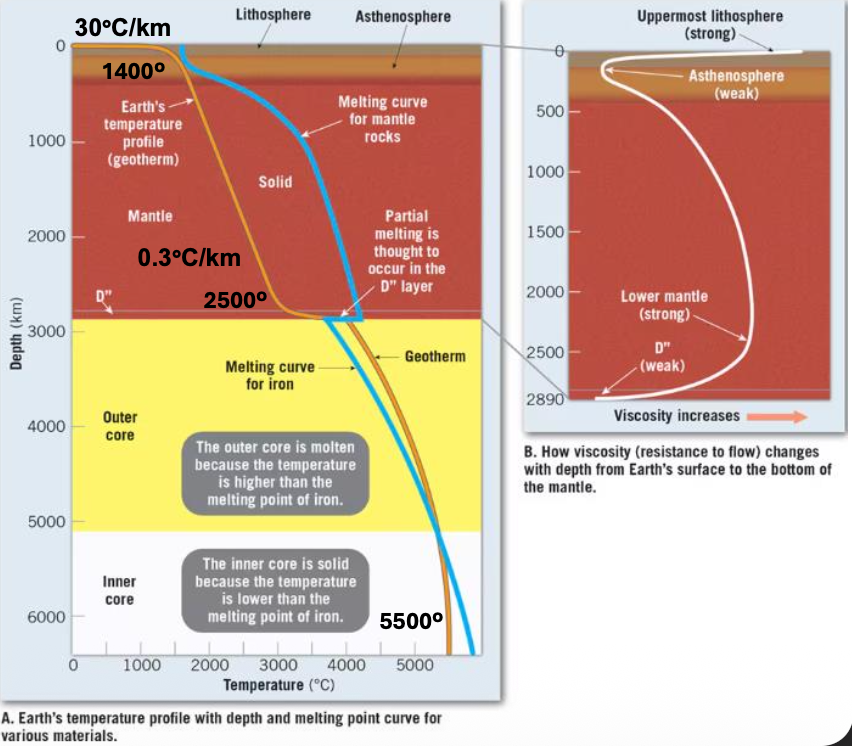
- The profile of Earth's temperature at each depth is called the geothermal gradient
Notes from the lecture:
- By the time you get to 100 km you have gotten pretty hot
- This diagram also shows what the melting curve looks like
- They are separated by distance and surface
- "Weaker because of partial melting going on"
- The average geothermal gradient in Earth’s crust is about 30°C per kilometer of depth.
12.5 Horizontal Variations in Earth's Interior
Discuss what seismic tomography has revealed about variations in Earth’s layers.
Earth's Gravity
Presentation content:
- Changes at the surface are due to Earth’s rotation
- Rotation causes a centrifugal force that is proportional to the distance from the axis of rotation
- Earth’s shape is an oblate ellipsoid (bulges at the equator), resulting in weaker gravity at the equator
- Other variations cannot be explained by Earth’s rotation:
- Bodies of unusually dense rock
- Metals, metal ores
- Other variations cannot be explained by Earth’s rotation:
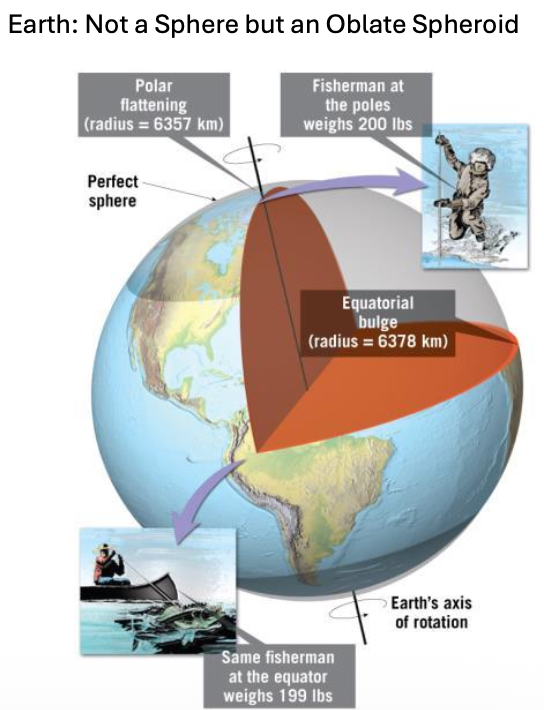
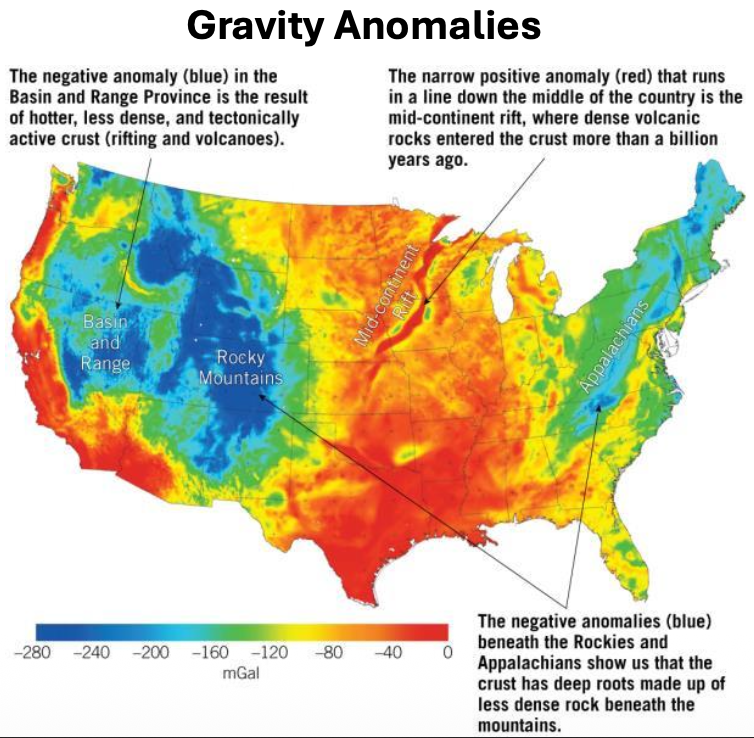
- Recognize that one time US was about to split in half.
Seismic Tomography
Presentation content:
- Seismic tomography involves collecting data at many different seismic stations to “see” parts of Earth’s interior in three dimensions
- Three-dimensional changes in composition and density are detected with gravity measurements and can be viewed using seismology
- Identifies regions where P and S waves travel faster or slower than average
- Variations in P and S wave velocities allow scientists to image subducting plates and mantle plumes
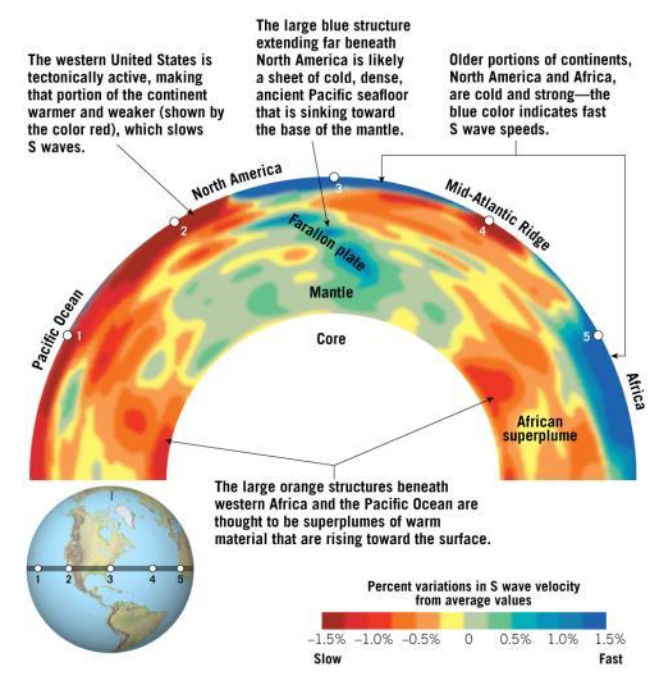
Notes from the lecture:
- You can see plumes appearing to be coming up from the mantle
- This is the first time we can see inside the earth.
- Very careful work in order to identify these changes
- Remarkable that they can recognize such small changes (-1.5% to 1.5%)
Earth's Magnetic Field
Presentation content:
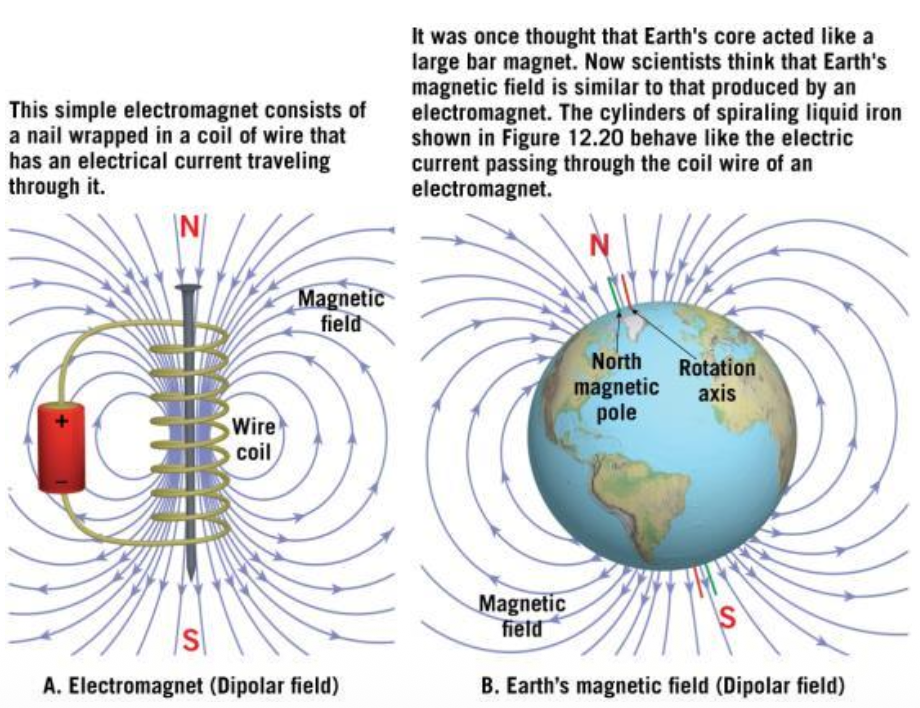
- Produced by convection of liquid iron in the outer core
- A geodynamo is the magnetic field caused by spiraling columns of rising electrically charged fluid in the outer core
- It is primarily dipolar but considerably more complex
- Patterns of convection change rapidly enough so that the magnetic field varies noticeably over our lifetimes
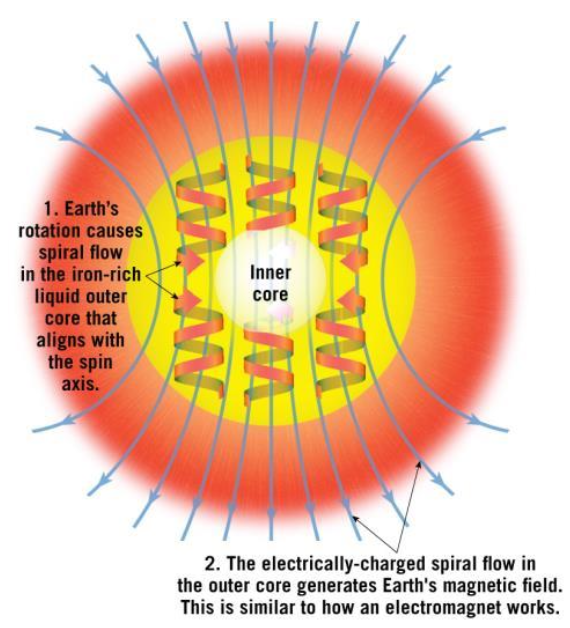
- Measuring Earth’s magnetic field and its changes
- The magnetic field is measured by declination and inclination
- Declination measures the direction of magnetic north pole with respect to the geographic north pole
- Inclination measures the downward tilt of the magnetic lines
- The locations of magnetic poles change significantly over time
- The magnetic field is measured by declination and inclination
Notes from the lecture:
- Due to the convection of the liquid in the outer core
Magnetic Reversals
Presentation content:
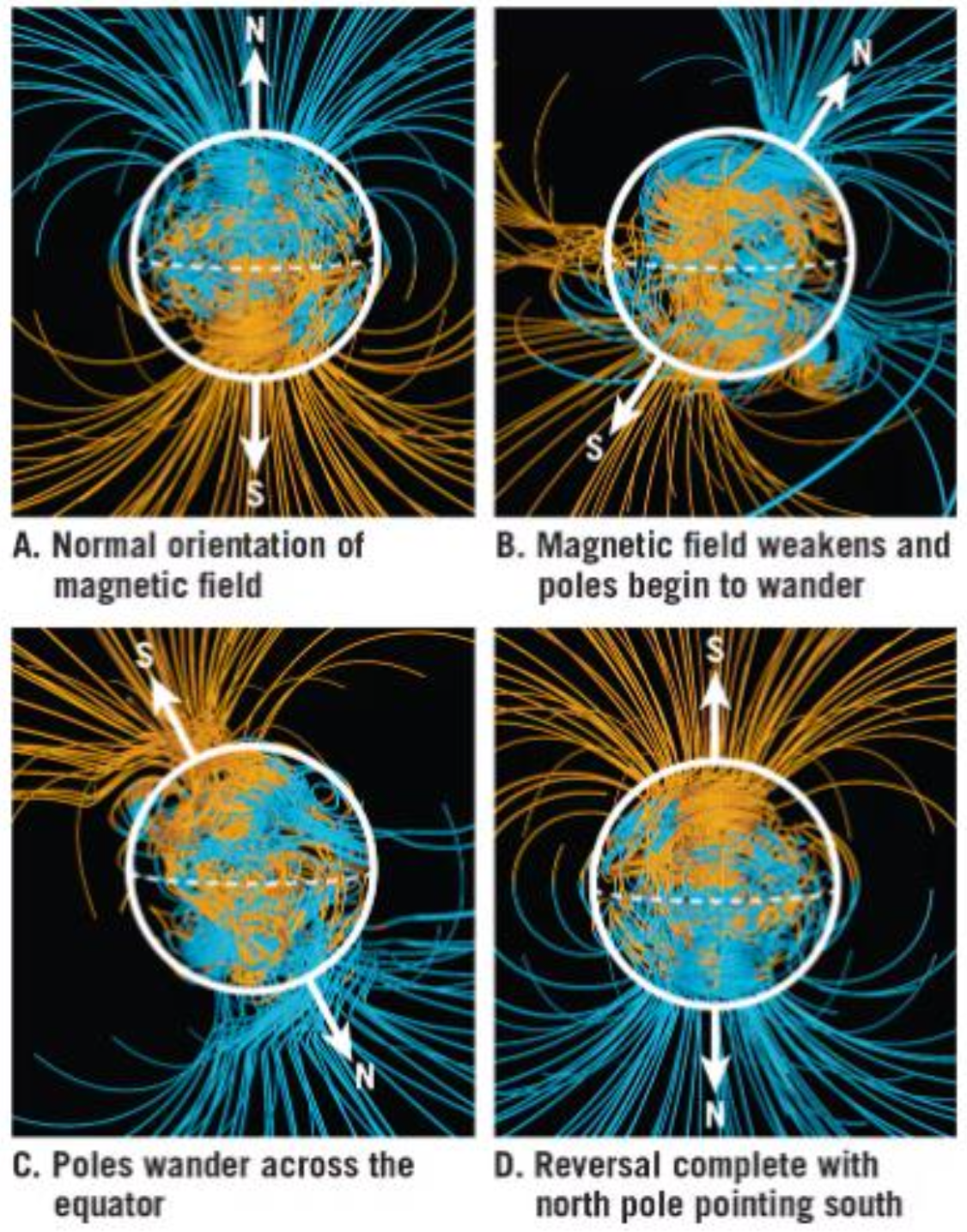
- The magnetic field randomly reverses, and north and south poles swap direction
- Reversal takes only a few thousand years, but during that time, the magnetic field, which protects Earth from solar wind, significantly decreases—to about 10% of normal
- Evidence that convection patterns in the outer core change over relatively short time spans
- The discovery of reversals has been extremely important to the foundation of the theory of plate tectonics
Notes from the lecture:
- It is well stablished and it is what really allowed us to understand and detect plate tectonics in the first place by looking at oceanic crust crystals.
- Magnetic reversals are common
- Specially during the Cenozoic and Mesozoic but they end in the Jurassic, ...
Magnetic pole movement is speeding up
Presentation content:
Magnetic reversal may be coming soon? rapid change in magnetic north, weakening magnetic field, larger area having aurora borealis
'takes 100s or 1000's years'
- But it is really untested
loss of protection from solar wind
expect power grind, communication, and satellite failures (not climate change, not extinction, but BAD for human civilization)
Notes from the lecture:
- Magnetic field protects earth:
- The magnetic field is very important to protect us from solar radiations
- Coronal mass ejection 100 years cycles?
- Magnetic reversals:
- Not related to climate change, not related to extinction
- We have many many cycles in a couple billion years
- We really cannot predict these reversals
- It would be bad for us though.
- Magnetic map of North America and surrounding oceans
- Rocks have different magnetic signatures
- Reveal deep structures and discontinuities on continent
- Magnetic reversals seen in oceans
- Speculation of the reason of reversals?
- Thermally driven motions associated with ...
- Causes more pull reactivity from the base of the mantle and creating more igneous activity on the sourface and because of this disruption in the mantle, it causes the magnetic changes/reersals
- Reversals only last for several tens of thousands of years, not that much.
Global dynamic connections
Presentation content:
- Global dynamic connections: Earth’s layers are connected by their thermally driven motions
- Example: The break-up of Pangaea
- Break-up of Pangaea led to an increase in subduction of sea-floor, leading to an increase in cold, suducted slabs at the core-mantle boundary
- Cold slabs displaced hot rocks at the core–mantle boundary causing an increase in mantle plume activity
- Cold slabs disrupted outer core convection and magnetic reversal activity
End of Chapter 12 - Concept Checks
12.1 Exploring Earth’s Interior
- List the three compositionally distinct layers of Earth’s interior.
- Provide evidence that points to the mantle being composed of the rock peridotite.
- What do meteorites tell us about the composition of Earth’s core?
- Explain what seismic waves tell us about Earth’s interior.
12.2 Earth’s Layered Structure
- How do continental crust and oceanic crust differ?
- List and briefly describe the composition and physical properties of the layers of the mantle.
- Compare and contrast Earth’s inner and outer cores.
12.3 Discovering Earth’s Layers
- Name the boundary that separates the crust and the mantle and describe how it was discovered.
- What seismic evidence tells us that Earth’s outer core is molten?
12.4 Earth’s Temperature
- What were the two sources of Earth’s original internal heat?
- List the two mechanisms of heat transfer that operate inside Earth.
- Which mechanism of heat transfer is dominant in the mantle?
12.5 Horizontal Variations in Earth’s Interior
- Is Earth’s force of gravity equal over its entire surface? Explain why or why not.
- Describe how the locations of the magnetic poles change through time.
- Give an example of a tectonic structure revealed by seismic tomography.