Certificate Transparency (CT) Logs
In the sprawling mass of the internet, trust is a fragile commodity. One of the cornerstones of this trust is the Secure Sockets Layer/Transport Layer Security (SSL/TLS) protocol, which encrypts communication between your browser and a website. At the heart of SSL/TLS lies the digital certificate, a small file that verifies a website's identity and allows for secure, encrypted communication.
However, the process of issuing and managing these certificates isn't foolproof. Attackers can exploit rogue or mis-issued certificates to impersonate legitimate websites, intercept sensitive data, or spread malware. This is where Certificate Transparency (CT) logs come into play.
What are Certificate Transparency logs?
Certificate Transparency (CT) logs are public, append-only ledgers that record the issuance of SSL/TLS certificates. Whenever a Certificate Authority (CA) issues a new certificate, it must submit it to multiple CT logs. Independent organizations maintain these logs and are open for anyone to inspect.
Think of CT logs as a global registry of certificates. They provide a transparent and verifiable record of every SSL/TLS certificate issued for a website. This transparency serves several crucial purposes:
- Early Detection of Rogue Certificates: By monitoring CT logs, security researchers and website owners can quickly identify suspicious or misissued certificates. A rogue certificate is an unauthorized or fraudulent digital certificate issued by a trusted certificate authority. Detecting these early allows for swift action to revoke the certificates before they can be used for malicious purposes.
- Accountability for Certificate Authorities: CT logs hold CAs accountable for their issuance practices. If a CA issues a certificate that violates the rules or standards, it will be publicly visible in the logs, leading to potential sanctions or loss of trust.
- Strengthening the Web PKI (Public Key Infrastructure): The Web PKI is the trust system underpinning secure online communication. CT logs help to enhance the security and integrity of the Web PKI by providing a mechanism for public oversight and verification of certificates.
How Certificate Transparency Logs Work?
Certificate Transparency logs rely on a clever combination of cryptographic techniques and public accountability:
- Certificate Issuance: When a website owner requests an
SSL/TLS certificatefrom a Certificate Authority (CA), the CA performs due diligence to verify the owner's identity and domain ownership. Once verified, the CA issues apre-certificate, a preliminary certificate version. - Log Submission: The CA then submits this
pre-certificateto multiple CT logs. Each log is operated by a different organisation, ensuring redundancy and decentralisation. The logs are essentiallyappend-only, meaning that once a certificate is added, it cannot be modified or deleted, ensuring the integrity of the historical record. - Signed Certificate Timestamp (SCT): Upon receiving the
pre-certificate, each CT log generates aSigned Certificate Timestamp (SCT). ThisSCTis a cryptographic proof that the certificate was submitted to the log at a specific time. TheSCTis then included in the final certificate issued to the website owner. - Browser Verification: When a user's browser connects to a website, it checks the certificate's
SCTs. TheseSCTsare verified against the public CT logs to confirm that the certificate was issued and logged correctly. If theSCTsare valid, the browser establishes a secure connection; if not, it may display a warning to the user. - Monitoring and Auditing: CT logs are continuously monitored by various entities, including security researchers, website owners, and browser vendors. These monitors look for anomalies or suspicious certificates, such as those issued for domains they don't own or certificates violating industry standards. If any issues are found, they can be reported to the relevant
CAfor investigation and potential revocation of the certificate.
The Merkle Structure
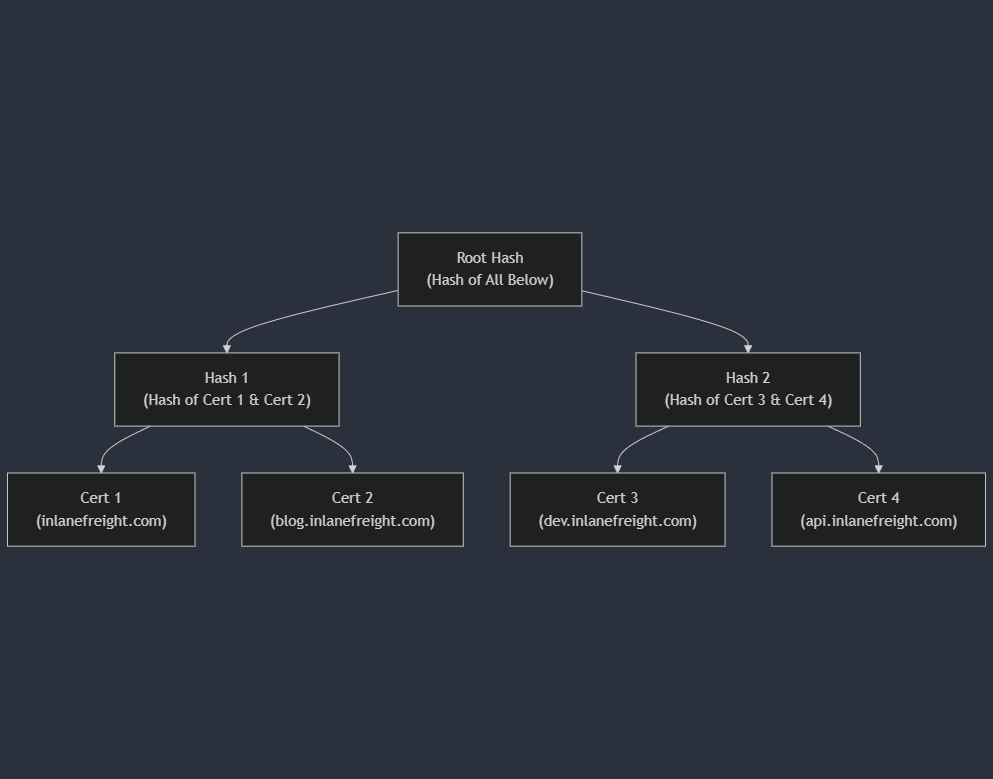
To ensure CT logs' integrity and tamper-proof nature, they employ a Merkle tree cryptographic structure. This structure organises the certificates in a tree-like fashion, where each leaf node represents a certificate, and each non-leaf node represents a hash of its child nodes. The root of the tree, known as the Merkle root, is a single hash representing the entire log.
Let's visualise this with a hypothetical Merkle tree for inlanefreight.com:
In this hypothetical tree:
Root Hash: The topmost node, a single hash representing the entire log's state.Hash 1 & Hash 2: Intermediate nodes, each a hash of two child nodes (either certificates or other hashes).Cert 1 - Cert 4: Leaf nodes representing individual SSL/TLS certificates for different subdomains ofinlanefreight.com.
This structure allows for efficient verification of any certificate in the log. By providing the Merkle path (a series of hashes) for a particular certificate, anyone can verify that it is included in the log without downloading the entire log. For instance, to verify Cert 2 (blog.inlanefreight.com), you would need:
Cert 2's hash: This directly verifies the certificate itself.Hash 1: Verifies that Cert 2's hash is correctly paired with Cert 1's hash.Root Hash: Confirms that Hash 1 is a valid part of the overall log structure.
This process ensures that even if a single bit of data in a certificate or the log itself is altered, the root hash will change, immediately signaling tampering. This makes CT logs an invaluable tool for maintaining the integrity and trustworthiness of SSL/TLS certificates, ultimately enhancing internet security.
CT Logs and Web Recon
Certificate Transparency logs offer a unique advantage in subdomain enumeration compared to other methods. Unlike brute-forcing or wordlist-based approaches, which rely on guessing or predicting subdomain names, CT logs provide a definitive record of certificates issued for a domain and its subdomains. This means you're not limited by the scope of your wordlist or the effectiveness of your brute-forcing algorithm. Instead, you gain access to a historical and comprehensive view of a domain's subdomains, including those that might not be actively used or easily guessable.
Furthermore, CT logs can unveil subdomains associated with old or expired certificates. These subdomains might host outdated software or configurations, making them potentially vulnerable to exploitation.
In essence, CT logs provide a reliable and efficient way to discover subdomains without the need for exhaustive brute-forcing or relying on the completeness of wordlists. They offer a unique window into a domain's history and can reveal subdomains that might otherwise remain hidden, significantly enhancing your reconnaissance capabilities.
Searching CT Logs
There are two popular options for searching CT logs:
| Tool | Key Features | Use Cases | Pros | Cons |
|---|---|---|---|---|
| crt.sh | User-friendly web interface, simple search by domain, displays certificate details, SAN entries. | Quick and easy searches, identifying subdomains, checking certificate issuance history. | Free, easy to use, no registration required. | Limited filtering and analysis options. |
| Censys | Powerful search engine for internet-connected devices, advanced filtering by domain, IP, certificate attributes. | In-depth analysis of certificates, identifying misconfigurations, finding related certificates and hosts. | Extensive data and filtering options, API access. | Requires registration (free tier available). |
crt.sh lookup
While crt.sh offers a convenient web interface, you can also leverage its API for automated searches directly from your terminal. Let's see how to find all 'dev' subdomains on facebook.com using curl and jq:
m4cc18@htb[/htb]$ curl -s "https://crt.sh/?q=facebook.com&output=json" | jq -r '.[]
 | select(.name_value | contains("dev")) | .name_value' | sort -u

*.dev.facebook.com
*.newdev.facebook.com
*.secure.dev.facebook.com
dev.facebook.com
devvm1958.ftw3.facebook.com
facebook-amex-dev.facebook.com
facebook-amex-sign-enc-dev.facebook.com
newdev.facebook.com
secure.dev.facebook.com
curl -s "https://crt.sh/?q=facebook.com&output=json": This command fetches the JSON output from crt.sh for certificates matching the domainfacebook.com.jq -r '.[] | select(.name_value | contains("dev")) | .name_value': This part filters the JSON results, selecting only entries where thename_valuefield (which contains the domain or subdomain) includes the string "dev". The-rflag tellsjqto output raw strings.sort -u: This sorts the results alphabetically and removes duplicates.