Improper Inventory Management
Maintaining accurate and up-to-date documentation is essential for web APIs, especially considering their reliance on third-party users who need to understand how to interact with the API effectively.
However, as a web API matures and undergoes changes, it is crucial to implement proper versioning practices to avoid security pitfalls. Improper inventory management of APIs, including inadequate versioning, can introduce security misconfigurations and increase the attack surface. This can manifest in various ways, such as outdated or incompatible API versions remaining accessible, creating potential entry points for unauthorized users.
Scenario
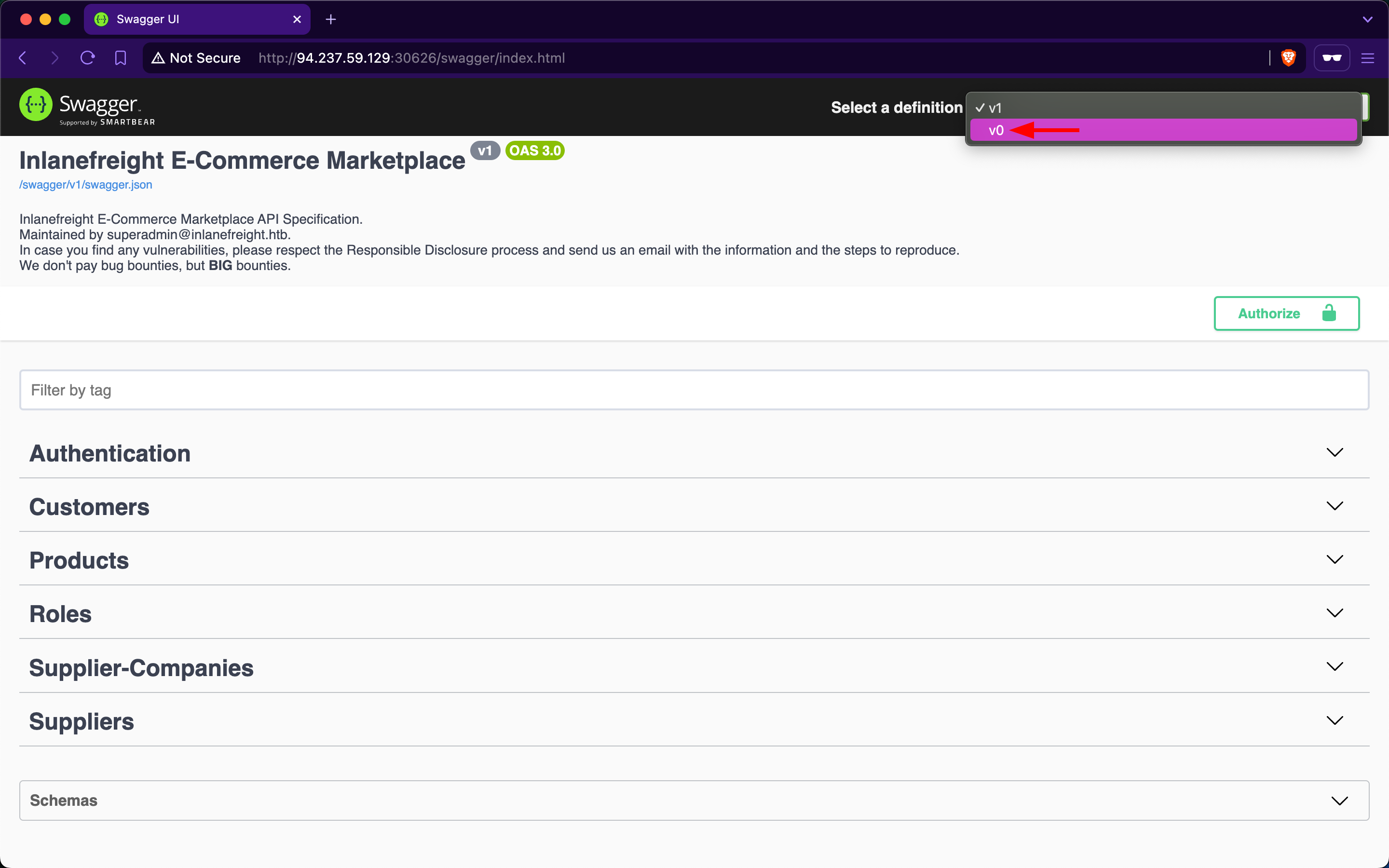
In the previous sections, we have primarily interacted with v1 of the Inlanefreight E-Commerce Marketplace web API. However, upon examining the Swagger UI's drop-down list for 'Select a definition', we discover the existence of an additional version, v0:
Upon reviewing the description of v0, it is indicated that this version contains legacy and deleted data, serving as an unmaintained backup that should be removed. However, upon inspecting the endpoints, we will notice that none of them display a 'lock' icon, indicating that they do not require any form of authentication:

Upon invoking the /api/v0/customers/deleted endpoint, the API responds by exposing deleted customer data, including sensitive password hashes:

Due to oversight by the developers in neglecting to remove the v0 endpoints, we gained unauthorized access to deleted data of former customers. This issue was exacerbated by an Excessive Data Exposure vulnerability in the /api/v0/customers/deleted endpoint, which allowed us to view customer password hashes. With this exposed information, we could attempt password cracking. Given the common practice of password reuse, this could potentially compromise active accounts, particularly if the same customers re-registered using the same password.
Prevention
Effective versioning ensures that only the intended API versions are exposed to users, with older versions properly deprecated or sunset. By thoroughly managing the API inventory, Inlanefreight E-Commerce Marketplace can minimize the risk of exposing vulnerabilities and maintain a secure user interface.
To mitigate the Improper Inventory Management vulnerability, developers at Inlanefreight E-Commerce Marketplace should either remove v0 entirely or, at a minimum, restrict access exclusively for local development and testing purposes, ensuring it remains inaccessible to external users. If neither option is viable, the endpoints should be protected with stringent authentication measures, permitting interaction solely by administrators.
Exercise
TARGET: 154.57.164.82:32290
Challenge 1
Exploit the Improper Inventory Management vulnerability and submit the value of the 'Email' field from the deleted Supplier Company with the ID 'c250cb38-96e3-4ccf-9df2-0a03146a2d0b'.
The first step is to of course access http://154.57.164.82:32290/swagger/ on a browser. Then use the "Select a definition" function to change from v1 to v0 implementation:

Then look at the available endpoints from v0 implementation:
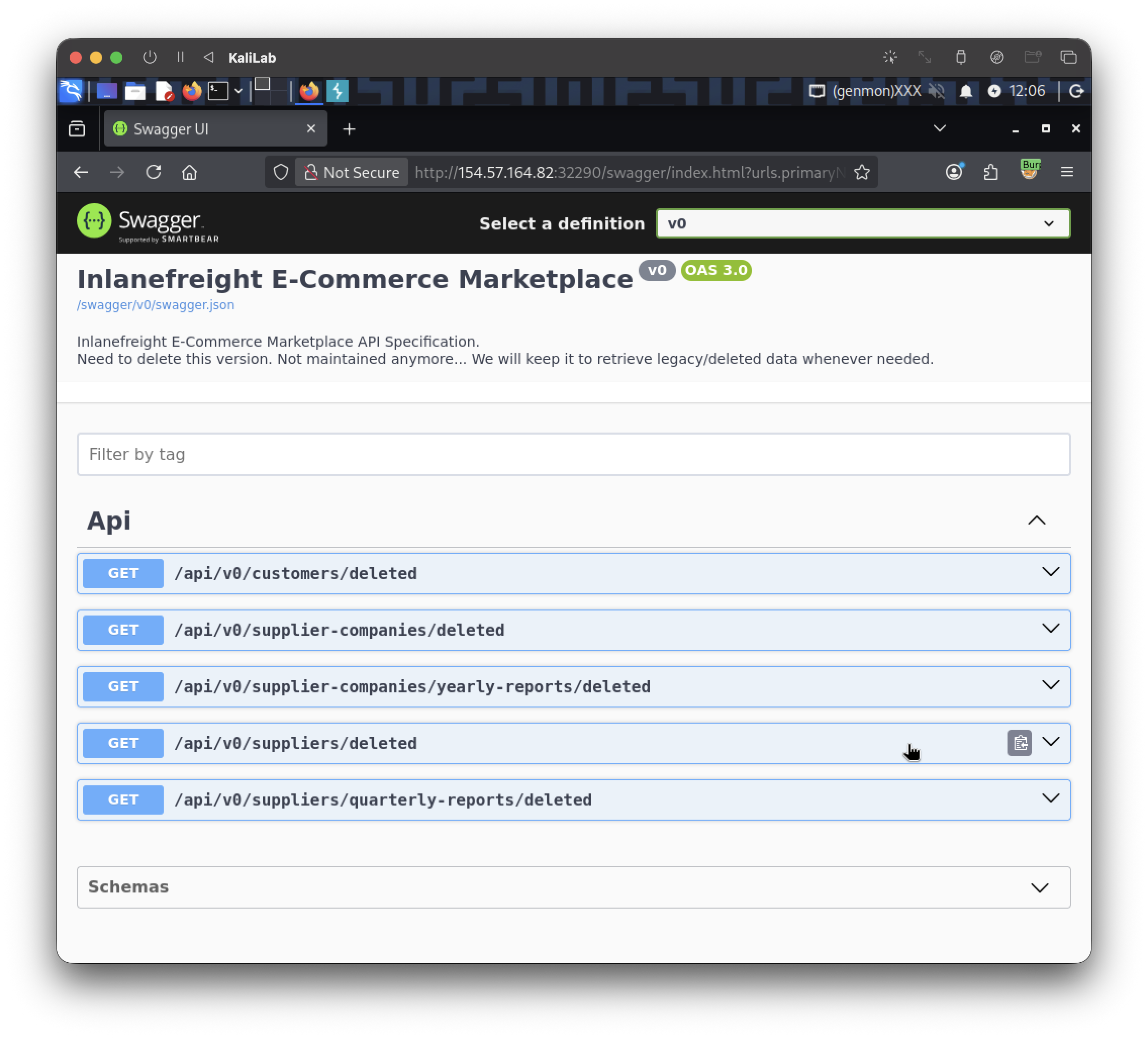
Since we are asked about a "deleted supplier", lets first try to execute the /api/v0/supplier-companies/deleted endpoint:
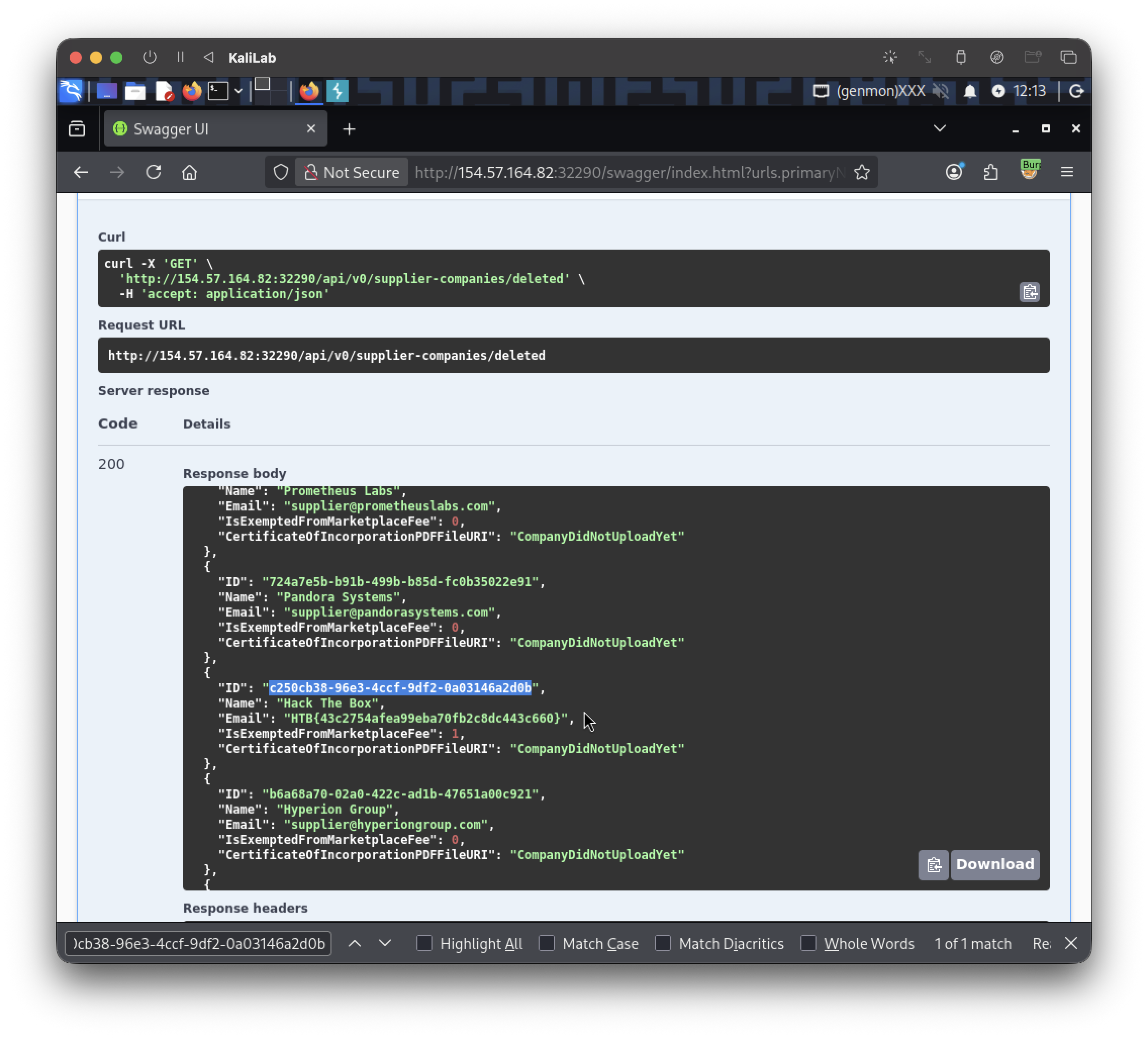
- There is no lock or authentication required so we are able to execute it
Looking (Ctrl + F) for CompanyID: c250cb38-96e3-4ccf-9df2-0a03146a2d0b we get 1 match:
  {
    "ID": "c250cb38-96e3-4ccf-9df2-0a03146a2d0b",
    "Name": "Hack The Box",
    "Email": "HTB{43c2754afea99eba70fb2c8dc443c660}",
    "IsExemptedFromMarketplaceFee": 1,
    "CertificateOfIncorporationPDFFileURI": "CompanyDidNotUploadYet"
  }
flag: HTB